
Woodland, trees and hedgerows priorities and potential measures
The Strategy aims to safeguarded from loss the county’s native woodland, trees and hedgerows and bring them under appropriate and active management, delivering robust ground flora and soil structures. Through a mixture of natural regeneration and new establishment, it also aims to improve connectivity and with woodland and trees providing an even greater contribution to climate change mitigation and resilience.
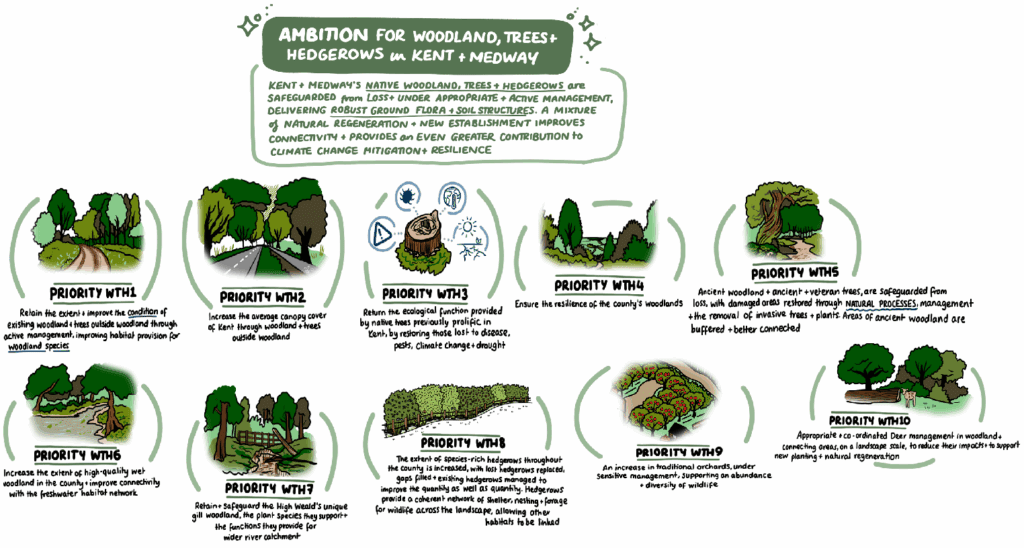
Click on the priorities below to view the associated potential measures. You can download all the woodland, trees and hedgerows priorities and measures in the document at the end of the page. Where a number appears missing, this is because it is associated with a wider measures. Wider measures are not a formal element of the Strategy and are therefore not included in the list below – however they are included in the downloadable measures documents.
- Priority WTH1 – Retain the extent and improve the condition of existing woodland and trees outside woodland through active management, improving habitat provision for woodland species.
Potential measure WTH1.2 Restore and extend lowland and upland wood pasture and parkland.
Potential measure WTH1.3 Safeguard and enhance small pockets of woodland to provide key stepping stones for species movement and connect with hedgerows and scrub.
- Priority WTH2 – Increase the average canopy cover of Kent through woodland and trees outside woodland.
Potential measure WTH2.1 Extend existing woodland through natural colonisation and planting.
Potential measure WTH2.2 Convert unproductive land for arable into woodland.
Potential measure WTH2.5 Plant more urban trees and create urban forests and orchards, ideally siting tree planting to where they will provide flood management, air quality and temperature regulation benefits.
- Priority WTH3 – Return the ecological function provided by native trees previously prolific in Kent, by restoring those lost to disease, pests, climate change and drought.
There are no potential or wider measures for this priority. This priority first requires a better understanding of areas where restoration of lost trees should be targeted – then appropriate land management can be implemented to return lost trees and their ecological function.
- Priority WTH4 – Ensure the resilience of the county’s woodlands.
Potential measure WTH4.2 Where appropriate, promote the restoration of plantations on ancient woodland sites to a more species-rich woodland.
Potential measure WTH4.4 Establish green bridges to connect woodlands fragmented by road and rail.
- Priority WTH5 – Ancient woodland, and ancient and veteran trees, are safeguarded from loss, with damaged areas restored through natural processes, management and the removal of invasive trees and plants. Areas of ancient woodland are buffered and better connected.
Potential measure WTH5.3 Buffer solitary ancient and veteran trees with open space, with further protections offered by establishing neighbouring wood pasture and agroforestry of mixed habitats.
Potential measure WTH5.4 Connectivity of ancient woodland improved by links to hedgerows, establishing standard trees and increasing standing deadwood.
- Priority WTH6 – Increase the extent of high-quality wet woodland in the county and improve connectivity with the freshwater habitat network.
Potential measure WTH6.1 Establish and implement long-term management plans for wet woodland and surrounding land, which ensures connectivity between waterways and woodland and incorporates nature-based water management solutions, such as leaky dams, felling, and blocking drainage channels to allow for seasonal flooding.
Potential measure WTH6.2 Create ponds within woodlands and naturally regenerated riparian zones.
- Priority WTH7 – Retain and safeguard the High Weald’s unique gill woodland, the plant species they support and the important functions they provide for the wider river catchment.
Potential measure WTH7.1 Create buffer zones around the gill woodland to ensure they remain largely undisturbed.
- Priority WTH8 – The extent of species-rich hedgerows throughout the county is increased, with lost hedgerows replaced, gaps filled and existing hedgerows managed to improve the quality as well as quantity. Hedgerows provide a coherent network of shelter, nesting and forage for wildlife across the landscape, allowing other habitats to be linked.
There are no potential measures for this priority, which is supported by wider measures. Wider measures are applicable in the case of this priority, as a result of the broad areas where the measures could be applied – bringing back a coherent species-rich hedgerows right across the county.
- Priority WTH9 – An increase in traditional orchards, under sensitive management, supporting an abundance and diversity of wildlife.
Potential measure WTH9.1 Restore and bring established traditional orchards back into positive management, including maintaining long sward length, establishing wildflower meadow strips between trees, limited or no spraying, sensitive pruning and retaining dead wood/dying trees.
Potential measure WTH9.2 Establish new community orchards in appropriate areas, with a focus on urban locations.
- Priority WTH10 – Appropriate and co-ordinated Deer management in woodland and connecting areas, on a landscape scale, to reduce their impacts and to support new planting and natural regeneration.
There are no potential or wider measures for this priority. This priority first requires a better understanding of Deer numbers and distribution in Kent – then appropriate land management can be implemented to reduce impacts.
Woodland, trees and hedgerows priorities - potential measures and wider measures
Woodland, trees and hedgerows priorities – potential measures and wider measures
Download PDF (97 KB) - Wood Trees Hedge Priorities And Potential Measures
Searchable potential measures and wider measures listings - all priorities
Searchable potential measures listing

Searchable wider measures listing