
Freshwater habitat priorities and potential measures
The Strategy aims to deliver freshwater habitats that are clean, sufficient and stable, in a healthy and good ecological state and supporting an abundance and diversity of species. Further it aims to see catchments’ functions restored, to deliver a connected mosaic of wet habitats, improving water quality and managing flood risk across the county.
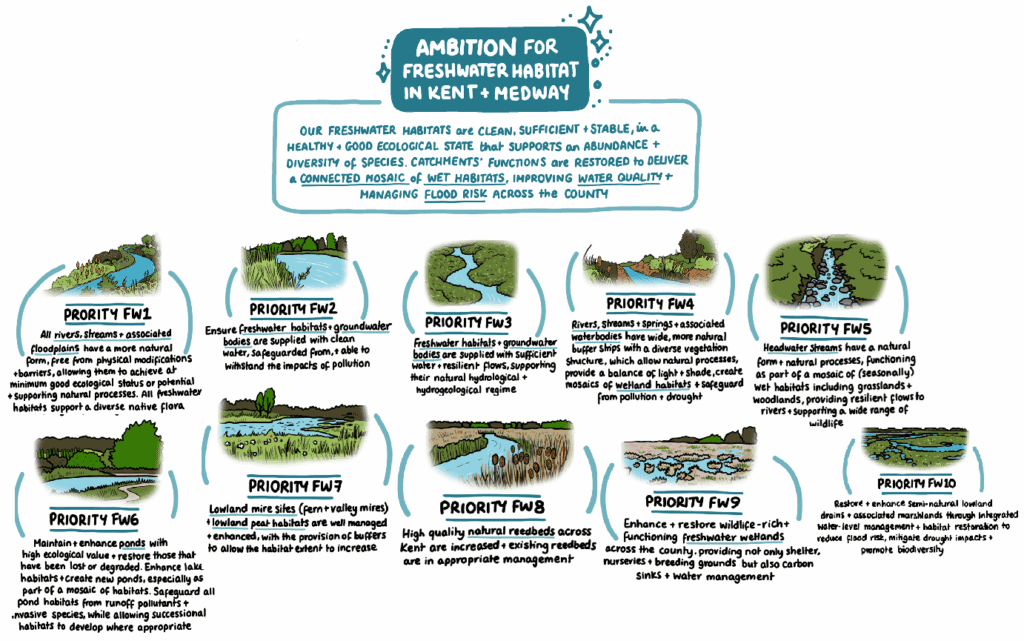
Click on the priorities below to view the associated potential measures. You can download all the freshwater priorities and measures in the document at the end of the page. Where a number appears missing, this is because it is associated with a wider measures. Wider measures are not a formal element of the Strategy and are therefore not included in the list below – however they are included in the downloadable measures documents.
- Priority FW1 – All rivers and streams and their associated floodplains have a more natural form, free from physical modifications and barriers, allowing them to achieve at minimum good ecological status or potential and supporting natural processes. All freshwater habitats support a diverse native flora.
Potential measure FW1.2 Undo historical physical modifications which have disconnected rivers and floodplains and restore natural processes through a range of approaches, including supplying woody material and allowing it to remain in the channel where it is not causing a flood risk, restoring channel stage zero, restoring historic meanders, bed raising, regrading banks to create shallow edges, and establishing mosaics of water meadows, wet grasslands and wet woodlands to allow inundation of floodplains above Q10 flows.
Potential measure FW1.3 Restore a more natural shape of channels by narrowing overwide channels, especially where siltation, uniform and low flows, and lack of habitat diversity are a pressure.
Potential measure FW1.4 Open up and daylight culverted rivers, streams and ditches, including ephemeral/seasonal streams where modification is redundant.
- Priority FW2 – Ensure freshwater habitats and groundwater bodies are supplied with clean water, and are safeguarded from, and able to withstand, the impacts of pollution.
Potential measure FW2.4 Prevent road runoff entering rivers by installing sustainable urban drainage systems or similar nature-based interception features on highways and local roads.
- Priority FW3 – Freshwater habitats and groundwater bodies are supplied with sufficient water and resilient flows, supporting their natural hydrological and hydrogeological regime.
Potential measure FW3.2 Retain and enhance habitats that support infiltration, such as grasslands, woodland, reedbeds and lowland peat. Avoid reducing infiltration in key recharge areas and around chalk stream winterbournes.
Potential measure FW3.3 Slow the flow and store water in the catchment in areas of low agricultural productivity or where there is space in urban areas, by working with natural processes to implement natural flood management e.g. by installing large woody material, and creating wet woodlands, lowland meadows, reedbeds, flood attenuation ponds and similar, especially where they can reduce flood risk and provide clean recharge to the groundwater body.
- Priority FW4 – Rivers, streams and springs, and their associated waterbodies, have wide, more natural buffer strips with a diverse vegetation structure, which allow natural processes, provide a balance of light and shade, create mosaics of wetland habitats and safeguard from pollution and drought.
Potential measure FW4.1 Establish and maintain wide areas of semi-natural, complex habitats along the banks of rivers and streams (including seasonal and headwater reaches), allowing light grazing of wet grassland areas with a focus on native livestock breeds, and encouraging woodland, particularly where there is a need for more shading of rivers to provide cooler temperatures, by increasing riparian tree cover to 30%. Allow the natural regeneration of habitats and recolonisation.
Potential measure FW4.2 Use the redevelopment of old infrastructure as an opportunity to re-naturalise river corridors (e.g. old industrial sites).
Potential measure FW4.3 Combine buffers with the use of nature-based solutions to hold water on floodplains in areas upstream of communities at risk of flooding, and clean water. This could include, for example, large woody debris, sediment traps and floodplain wetlands.
- Priority FW5 – Headwater streams have a natural form and natural processes, functioning as part of a mosaic of (seasonally) wet habitats including grasslands and woodlands, providing resilient flows to rivers and supporting a wide range of wildlife.
Potential measure FW5.2 Restore and establish wetlands in headwater areas and around natural springs by reversing and preventing further drainage of springs and seepage areas.
Potential measure FW5.3 Re-naturalise urban and modified sections of headwaters, including ephemeral streams such as winterbournes, (e.g. where they have been straightened and deepened to drain woodlands and agricultural land), including through approaches such as stage 0 restoration.
- Priority FW6 – Maintain and enhance ponds with high ecological value and restore those that have been lost or degraded. Enhance lake habitats and create new ponds, especially as part of a mosaic of habitats. Safeguard all pond habitats from runoff pollutants and invasive species, while allowing successional habitats to develop where appropriate.
There are no potential measures for this priority, which is supported by wider measures. Wider measures are applicable in the case of this priority, as a result of the broad areas where the measures could be applied – bringing pond restoration and enhancement benefits across the county.
- Priority FW7 – Lowland mire sites (fen and valley mires) and lowland peat habitats are well managed and enhanced, with the provision of buffers to allow the habitat extent to increase.
Potential measure FW7.1 Manage existing fen and bog sites to reduce encroachment, including through scrub management and appropriate grazing.
Potential measure FW7.2 Create and maintain wide buffers around existing fen and bog sites to safeguard them from diffuse pollution.
Potential measure FW7.3 Restore lowland peat habitats by reversing drainage and supporting re-wetting of areas.
- Priority FW8 – High-quality natural reedbeds across Kent are increased, and existing reedbeds are in appropriate management.
There are no potential measures for this priority, which is supported by wider measures. Wider measures are applicable in the case of this priority, as a result of all reedbed areas requiring improved management – bringing reedbeds into better condition, and supporting an increase in their extent, across the county.
- Priority FW9 – Enhance and restore wildlife-rich and functioning freshwater wetlands across the county, providing not only shelter, nurseries and breeding grounds but also carbon sinks and water management.
Potential measure FW9.1 Enhance reservoirs and similar waterbodies to provide a better wildlife habitat. Ensure that any such water bodies include features that enable wildlife to get out of the water.
- Priority FW10 – Restore and enhance semi-natural lowland drains and associated marshlands through integrated water-level management and habitat restoration to reduce flood risk, mitigate drought impacts and promote biodiversity.
There are no potential or wider measures for this priority, which is instead supported by the widespread implementation of improved land management practices as detailed in the Strategy document.
Freshwater priorities - potential measures and wider measures
Freshwater priorities – potential measures and wider measures
Download PDF (85 KB) - Freshwater Priorities And Potential Measures
Searchable potential measures and wider measures listings - all priorities
Searchable potential measures listing

Searchable wider measures listing